The San Francisco AI Declaration, Summarized
Contents
On July 24, 2026, the Korean government laid out its AI policy direction at an AI summit in San Francisco. Korean media call it the “San Francisco AI Declaration.” Several concrete deals and MOUs were announced at the same event.
This post separates what was declared, what was actually signed, and what developers need to check right now.
The event
| Item | Detail |
|---|---|
| Event | San Francisco AI Summit |
| Date | July 24, 2026 (local time) |
| Venue | The Midway, San Francisco |
| Host | Ministry of Science and ICT (MSIT) |
| Size | ~150 executives, investors, researchers and founders |
US executives attending: Jensen Huang (NVIDIA), Sam Altman (OpenAI), Dario Amodei (Anthropic), Hock Tan (Broadcom). Korean side: Lee Jae-yong (Samsung Electronics), Chey Tae-won (SK Group), Chung Euisun (Hyundai Motor Group), Lee Hae-jin (Naver).
Korean AI startups were also present: Notta, Liner, Flitto, NewenAI, Sendbird, Moloco.
The format was bilateral meetings with the four US CEOs first, then the keynote where the declaration was delivered.
The four pillars
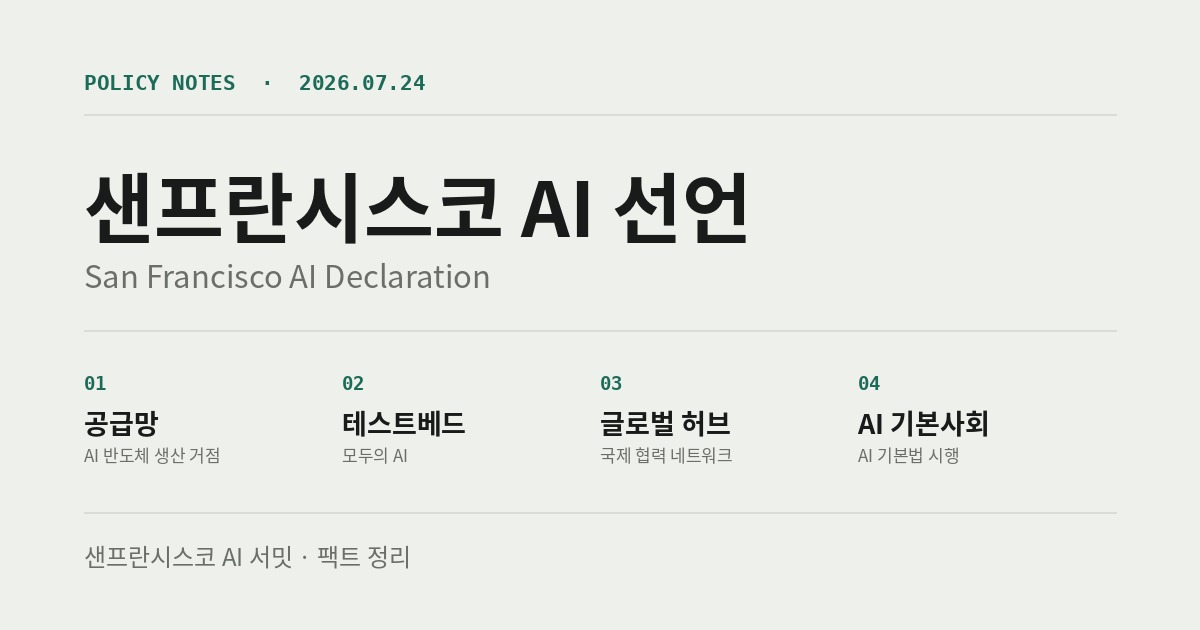
1. An irreplaceable global AI supply chain
Korea positions its memory semiconductor capacity as the basis for being a manufacturing and supply partner for AI chips, with production spread across the capital region and the provinces. The phrasing from the presidential policy chief’s briefing was that Korea would “supply memory stably under any circumstances.”
2. A world-class AI testbed
Becoming the country that adopts AI fastest, applying it across manufacturing, cities and logistics — a “global AI testbed and production platform.” The flagship program is “AI for All,” covered below.
3. Global AI Hub Initiative
Horizontal cooperation networks so developing countries can participate in AI innovation, including support for AI built around each country’s language, culture and industry.
This is not new here. A vision ceremony was held in Seoul on May 21, 2026, with nine international organizations (ILO, IOM, WHO among them) and five multilateral development banks (World Bank, ADB among them) as partners. San Francisco reframed it as an international “Initiative.”
4. An inclusive “AI Basic Society”
Grounded in the AI Framework Act that took effect in January 2026 — guaranteeing access to education and healthcare, with protections for SMEs, small merchants and vulnerable groups.
What was actually signed
More concrete than the declaration itself. These have figures and dates attached.
| Deal | Detail |
|---|---|
| NVIDIA · SK | $500B+ AI data center initiative plus next-gen memory partnership, including HBM co-development with SK Hynix |
| SK Telecom data center | 2GW, built on NVIDIA Vera Rubin and SK Hynix HBM4. First facility online 2027 |
| NVIDIA · Naver | $1B NVIDIA investment in Naver (Bloomberg). Data center expansion with Naver and Brookfield |
| NVIDIA · KAIST | Joint AI research lab at KAIST’s Kim Jaechul Graduate School of AI |
| NVIDIA · Hyundai | JV to develop an autonomous Genesis sedan |
| Anthropic · MSIT | Multiple MOUs covering AI security and cybersecurity testing |
| National Pension Service · 6 VCs | MOUs signed July 25 with a16z, General Catalyst, Sequoia, Khosla, Lightspeed and NEA |
Long-term memory supply contracts from Samsung Electronics and SK Hynix were announced, but no amounts or durations were disclosed.
No new agreement was announced with OpenAI. No outcome was published from the Broadcom meeting.
The numbers behind it
Most figures cited in the declaration were announced earlier. The category matters.
| Figure | Detail | Type |
|---|---|---|
| ~4,700T KRW | Three mega-projects, private investment (Samsung 2,655T / SK 2,100T) | Announced 2026-06-29 as stated investment intent, not committed or contracted capital |
| 18.4 GW | National AI data center buildout | Plan |
| 896T KRW | Honam regional cluster (SK ~470T / Samsung ~425T) | Plan |
| 550T KRW | AI infrastructure investment target | Target |
| 50,000 GPUs | Government procurement target by 2028 (B200-equivalent) | Target |
| 9.9T KRW | 2026 government AI budget (741 projects, 41 agencies) | Budgeted |
| 50 million | “AI for All” participation target | Target |
4,700T KRW is far larger than Korea’s GDP, which makes it easy to misread. It is the sum of long-horizon private investment plans, not committed spending. The Honam cluster figure also appears as both 896T and 825T depending on the source, likely a difference in what is counted.
The AI Framework Act — what actually binds
The legal basis for pillar 4, and already in force, which makes it the most practical part here.
Formally the Framework Act on AI Development and Establishment of a Foundation for Trustworthiness. Promulgated January 22, 2025 and in force since January 22, 2026. It is the second comprehensive national AI law after the EU AI Act, and since the EU delayed its high-risk provisions, Korea ended up applying full standards first.
High-impact AI — AI affecting human life or physical safety
- Verify high-impact status before shipping the product or service
- Implement risk management, explainability and human oversight
- Retain documentation for five years
- Publicly disclose key safeguards
Generative AI
- Notify users in advance that a generative model is in use
- Label generated output (human- or machine-readable)
- Deepfakes require an explicit visible marker
Domestic representative — required for foreign operators meeting any of:
- ≥1T KRW annual revenue
- ≥100B KRW AI-service revenue
- ≥1 million daily domestic users (3-month average)
Large-scale AI — cumulative training compute ≥10²⁶ FLOP
- Identify and mitigate risks, and submit documentation to MSIT
Fines run up to 30M KRW, but the government has stated a guidance-only period of at least a year with no fines, so actual penalties are unlikely before 2027.
The 10²⁶ FLOP threshold is not something an individual or a typical company will hit. The generative AI labelling duties, on the other hand, apply to most services built on top of an LLM API. That is the part worth checking first.
AI for All
The flagship program under pillar 2.
- Built on domestic AI foundation models, free nationwide, no usage caps
- Selected providers must build at least 50% of the service on domestic models
- Provider selection August 2026 → beta September → general launch within the year
- Planned expansion in 2027 into a “one person, one AI agent” service handling bookings and payments
On the sovereign model side, five teams were selected: Naver Cloud, Upstage, SK Telecom, NC AI and LG AI Research. The government has said it plans to release the supported models as open source in August 2026.
What could change
Splitting confirmed from planned:
Confirmed, with dates or figures
- SK Telecom’s 2GW data center comes online in 2027, which pins HBM4 and Vera Rubin demand to a specific date
- NVIDIA’s Naver investment and the data center expansion
- The NPS agreements with six Silicon Valley VCs, which open a foreign investment channel for Korean startups
- Anthropic’s AI security and testing MOUs with MSIT
- The NVIDIA–KAIST joint lab
Plans and targets
- The 4,700T mega-projects, the 18.4GW data center buildout and the 550T investment target are all plans
- The Samsung and SK Hynix long-term supply contracts were announced without amounts or durations
What developers should check now
The AI Framework Act is already in force. The guidance period suspends fines, not the obligations. If your service uses generative AI, start with user notification and output labelling.
On the memory side, KEIA puts Samsung Electronics and SK Hynix at roughly 80% of the HBM market combined, and the data center deals announced here stack on top of that. Per-company share figures conflict across sources, so the combined number is the safer one to cite.
Not verified
- No separate declaration document was found. Only the keynote full text is available
- Amounts and durations of the Samsung and SK Hynix long-term supply contracts
- The exact count and full scope of Anthropic’s MOUs
- Any outcome from the Broadcom meeting
- Whether the “AI for All” launch within 2026 is nationwide or an expanded beta
- No employment or job-creation target appears in any source
No new agency or regulatory change came out of the summit. The AI Framework Act and the National AI Committee both predate it; the declaration references them.
References
- Full text of the declaration — https://www.newspim.com/news/view/20260725000037
- Policy chief briefing — https://www.newspim.com/news/view/20260724000554
- Summit attendees and startups — https://zdnet.co.kr/view/?no=20260724101257
- NVIDIA · SK announcement — https://www.koreaherald.com/article/10819847
- Anthropic MOUs — https://www.koreaherald.com/article/10819800
- NVIDIA Korea blog — https://blogs.nvidia.co.kr/blog/ai-summit-korea-partners-and-nvidia/
- AI Framework Act explainer — https://www.shinkim.com/kor/media/newsletter/3114
- Three mega-projects — https://www.etnews.com/20260629000402
- KEIA analysis — https://keia.org/analysis/what-the-san-francisco-ai-summit-means-for-u-s-korea-tech-cooperation/