paper.archive/Opensource
Opensource

Analyzing log files with Python and Spark (with hadoop)

Contents

File analysis with Spark

I did this without really knowing spark or hadoop, so there will be mistakes.
For reference, this was done on OSX.

Setup

1. Install and run Hadoop

2. Put the file on hdfs.

1
2
cd /logs
hdfs dfs -put test.log /input/

You can browse files as below. Check the uploaded file here! http://localhost:50070/explorer.html#/input

3. Test spark’s python command..

$SPARK_HOME/bin/pyspark With hadoop running, launching pyspark shows this

 1
 2
 3
 4
 5
 6
 7
 8
 9
10
11
12
13
14
15
16
17
18
Python 2.7.10 (default, Oct 23 2015, 19:19:21)
[GCC 4.2.1 Compatible Apple LLVM 7.0.0 (clang-700.0.59.5)] on darwin
Type "help", "copyright", "credits" or "license" for more information.
16/05/30 16:12:16 INFO spark.SparkContext: Running Spark version 1.6.1
2016-05-30 16:12:17.194 java[5956:1259148] Unable to load realm info from SCDynamicStore
... 중략 ....
16/05/30 16:12:19 INFO storage.BlockManagerMasterEndpoint: Registering block manager localhost:50791 with 511.0 MB RAM, BlockManagerId(driver, localhost, 50791)
16/05/30 16:12:19 INFO storage.BlockManagerMaster: Registered BlockManager
Welcome to
      ____              __
     / __/__  ___ _____/ /__
    _\ \/ _ \/ _ `/ __/  '_/
   /__ / .__/\_,_/_/ /_/\_\   version 1.6.1
      /_/

Using Python version 2.7.10 (default, Oct 23 2015 19:19:21)
SparkContext available as sc, HiveContext available as sqlContext.
>>> 

4. Setting up the python environment (for spark-submit)

1
2
 # 환경변수 설정을 위해 아래 파일을 연다 (물론 OSX 기준)
 vi ~/.bash_profile

Add the following to .bash_profile

1
2
3
4
5
export SPARK_HOME=/Users/paper/dev/tool/spark
export PYTHONPATH=$SPARK_HOME/python/:$PYTHONPATH
export IPYTHON=1
export PYSPARK_PYTHON=python3.5
export PYSPARK_DRIVER_PYTHON=ipython

If you don’t have ipython, install it with the command below

1
pip install ipython
1
2
3
4
5
# 적용 
source ~/.bash_profile

# py4j는 pyspark가 사용하는 모듈이니 설치 해야 함 
pip3.5 install py4j

5. Write voicelog.py and run a quick test

1
2
3
4
5
6
7
#-*-coding: utf-8 -*-
from pyspark.context import SparkContext

sc = SparkContext()

t = sc.textFile("/input/test.log")
print(t.count())
1
$SPARK_HOME/bin/spark-submit --master local[4] voicelog.py

You can see the result like this

 1
 2
 3
 4
 5
 6
 7
 8
 9
10
16/05/30 17:52:58 INFO spark.SparkContext: Running Spark version 1.6.1
2016-05-30 17:52:58.646 java[7629:1534234] Unable to load realm info from SCDynamicStore
16/05/30 17:52:58 WARN util.NativeCodeLoader: Unable to load native-hadoop library for your platform... using builtin-java classes where applicable
16/05/30 17:52:58 INFO spark.SecurityManager: Changing view acls to: paper
... 중략 ...
16/05/30 17:53:03 INFO scheduler.DAGScheduler: Job 0 finished: count at /Users/paper/dev/git/createXlsFromDb/search_voice_log/voicelog.py:8, took 1.541395 s
145410
16/05/30 17:53:03 INFO spark.SparkContext: Invoking stop() from shutdown hook
... 중략 ...
16/05/30 17:53:03 INFO remote.RemoteActorRefProvider$RemotingTerminator: Remoting shut down.

Tool setup (IntelliJ IDEA)

Now that files are hooked up.. let’s connect it in intellij.

  1. Making pyspark visible in code
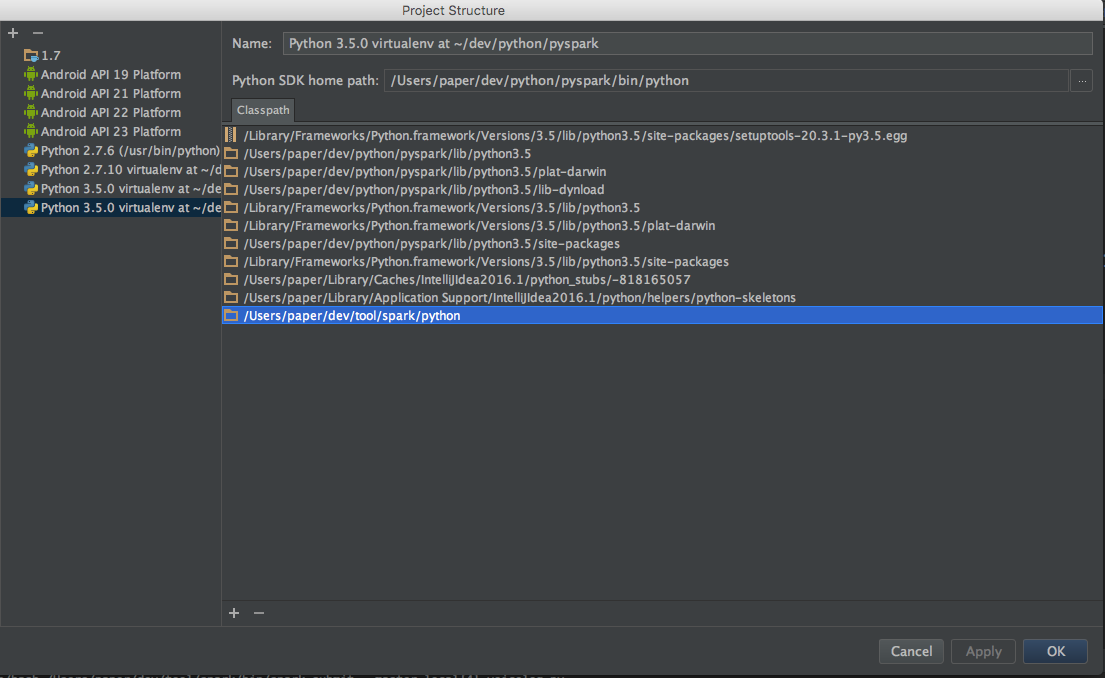
    In project settings, add the library to SDKs as shown below settings
  2. Hooking up the run script
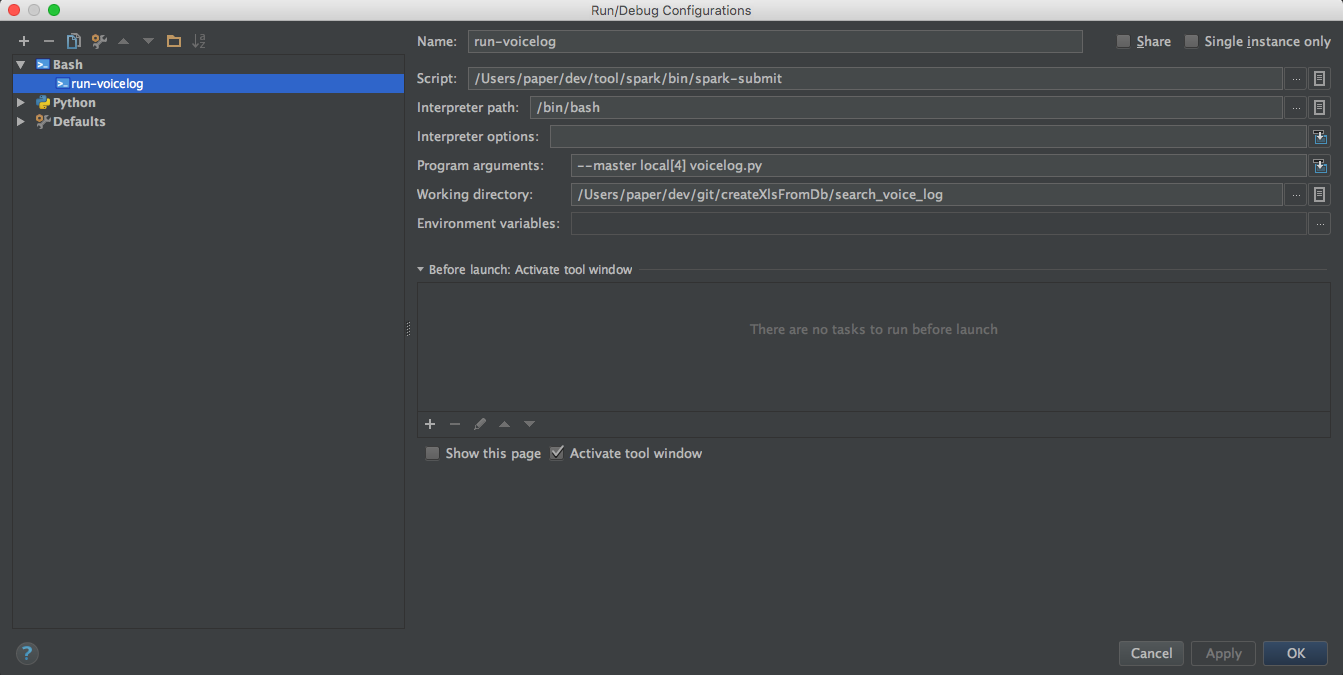
    settings

Configure it to run $SPARK_HOME/bin/spark-submit --master local[4] voicelog.py

Implementation: voicelog.py

 1
 2
 3
 4
 5
 6
 7
 8
 9
10
11
12
13
14
15
16
17
18
19
20
21
22
23
24
25
26
27
28
29
30
31
32
33
34
35
36
37
38
39
40
#-*-coding: utf-8 -*-
from pyspark.context import SparkContext


def mapLine(line):
    # lineblock를 불러와서 필요한 부분만 가공하여 tuple형태로 반환한다
    str = line[1][:line[1].find(".pcm")]
    str2 = str.split("/")
    sent_cd = str2[1][str2[1].find("_")+1:]
    data = str2[0] + "/" + sent_cd
    return (data, 1)

def printLine(line):
    print(line)

sc = SparkContext(appName="voicelog")
# /input/ 경로에 있는 모든 파일을 가져와서 분석을 실시한다 
# sc.textFile로 하려고 했으나.분석 대상이 multi line이어서 아래를 이용한다

t = sc.newAPIHadoopFile(
    '/input/',
    'org.apache.hadoop.mapreduce.lib.input.TextInputFormat',
    'org.apache.hadoop.io.LongWritable',
    'org.apache.hadoop.io.Text',
    conf={'textinputformat.record.delimiter': '/text/'}
)

# block중에 record가 포함되지 않고 -11문자열을 포함하는 block만 RDD로 뽑는다
l = t.filter(lambda data: "/record/" not in data[1] and "-11" in data[1])

# reduceByKey를 한 이유는 몇번이나 발생했는지를 나타낸다 - 사실 중복제거를 하려고 했는데. groupByKey를 사용해도 괜찮다
l = l.map(mapLine).reduceByKey(lambda a, b: a + b).collect()

# 결과 파일에 쓴다
f = open("result.log", "w")
for s in l:
    f.write("%s, %d\r\n" % (s[0], s[1]))
f.close()

print("완료")

How to run

1
$SPARK_HOME/bin/spark-submit --master local[4] voicelog.py

For reference, spark-submit --help shows many options

Running against a spark server

To set up a cluster and connect, it seems you run spark separately like below and use the spark address in the python code
haven’t tried it

1
$SPARK_HOME/sbin/start-all.sh

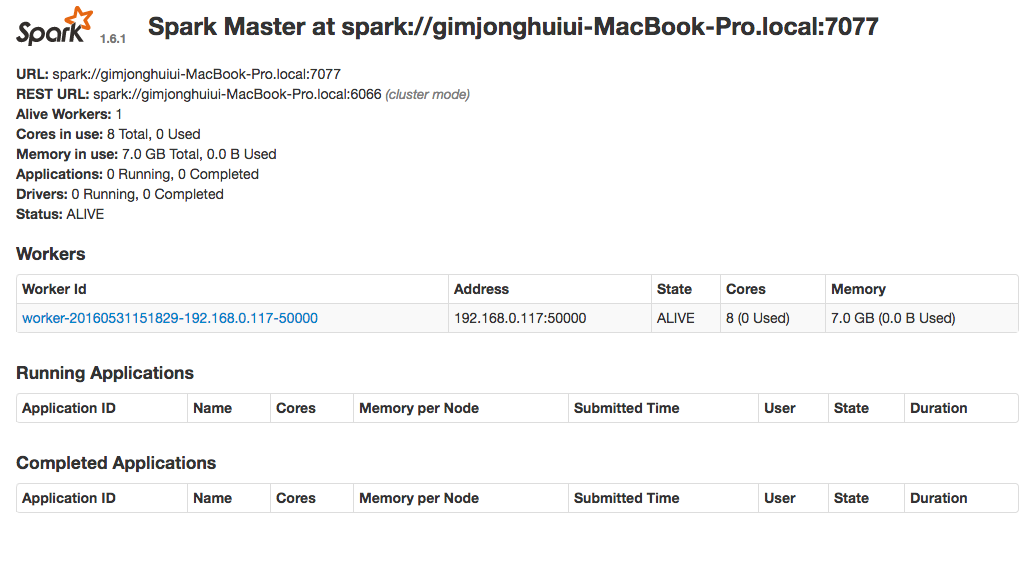
MasterUI capture

If you look closely at the MasterUI above, you can see the part starting with URL: spark://.

1
SparkContext("spark://.....", "voicelog")

Logs used to be just for error tracing so I had them auto-deleted after a period.. From now on I should keep them
Let’s start putting some valuable data in the logs